Tuesday, May 06, 2003
Monday, May 05, 2003
Monday, April 28, 2003
BTA - Bollettino Telematico dell'Arte / Testi / bta00205.html
Japanese Avant-Garde Theatre, including Butoh artists like Sangai Juku and Dai Rakuda Kan.
Japanese Avant-Garde Theatre, including Butoh artists like Sangai Juku and Dai Rakuda Kan.


Washingtonpost.com: At Height of Vietnam, Bush Picks Guard
This article mentions April Foley, whom he dated while attending Allston. He recently picked her for a post, the nature of which I will describe later.
This article mentions April Foley, whom he dated while attending Allston. He recently picked her for a post, the nature of which I will describe later.
Saturday, April 26, 2003
"As Phillips Brooks, a Protestant pastor in the late 19th century, wrote: "In the best sense of the word, Jesus was a radical.His religion has so long been identified with conservatismthat it is almost startling sometimes to remember that all the conservatives of his own times were against him; that it was the young, free, restless, sanguine, progressive part of the people who flocked to him.""
'America's best theologian' walks pacifist road
'America's best theologian' walks pacifist road
Boycott Mainstream Media and Tune in the World: How To Listen to Shortwave Broadcasts via Radio and the Internet - A Media Watch Special on BuzzFlash.com
"LISTENING TO SHORTWAVE BROADCASTS—VIA THE INTERNET
Many broadcasts are now streaming continuously via the Internet, offering their programming in English 24 hours a day. Other stations stream in English on the net only when they are beaming their radio signals in English via shortwave (parallel broadcasting). Many broadcasters also provide current news sections right on their sites. Here are several websites that can get you started listening with or without a radio!
Perhaps the easiest site to use is one entitled Shortwave Broadcasts LIVE On The Internet http://www.dxworld.com/sw_live.html. This site is basically an alphabetical listing of countries, with links to streaming broadcasts via Real Audio or Windows Media. Most countries stream continuously in the native language; others stream and also offer "in demand" archived broadcasts in English. Some stations provide only limited schedules and some parallel the shortwave broadcasts which are aired at certain times of the day. At the bottom of each listing there are links to the website of the broadcaster. As previously mentioned, these home pages often provide complete daily and weekly schedules of programming, including when broadcasts are aired specifically for North American audiences. Check out the TV feed from Cuba!
Another good site is the World Radio Network http://www.wrn.org/index.html. Based in London, this site offers a variety of ways to tune in. WRN culls some of the most popular news and cultural broadcasts from across the globe and bundles them into a variety of schedules geared for different regions http://www.wrn.org/listeners/schedules/. For example, English broadcasts are available in formats for WRN English for Africa/Middle East, Europe, Asia Pacific, North America, and South America. As an example, on the WRN English for North America channel, weekday evenings feature programming from Russia, Slovakia, China, Israel, Poland, Hungary, the Netherlands, Sweden, Germany, and UN Radio. NPR Radio programs from the US also show up on the schedules. There are also multilingual broadcasts for North America. By selecting any of these formats you will see a daily schedule in Universal Time (UTC) along with the applicable time zones for that part of the world. Or, you can click on "Listen Now" and pick up whatever is broadcasting at the moment.
There is also a listing of all the broadcasters that are available on WRN http://www.wrn.org/listeners/stations/index.php?CurrentLetter=1. Clicking on a station brings you to a page which describes the broadcast availability (language and time) as well as a direct link to the station's website. These informational pages are also available by clicking the program names on the master schedule for that region.
"
MORE
Friday, April 25, 2003
Tuesday, April 22, 2003
Saturday, April 19, 2003
Friday, April 18, 2003
Thursday, April 17, 2003
Tuesday, April 15, 2003
Ronald Reagan Jr. on George W. Bush
Salon.com News | Reagan blasts Bush
"My father crapped bigger ones than George Bush," says the former president's son, in a flame-throwing conversation about the war and the Bush administration's efforts to lay claim to the Reagan legacy."
Salon.com News | Reagan blasts Bush
"My father crapped bigger ones than George Bush," says the former president's son, in a flame-throwing conversation about the war and the Bush administration's efforts to lay claim to the Reagan legacy."
TELEVISION ADDICTION & THE BLOG REMEDY
"Some of the most sophisticated news consumers, including progressives worldwide, have become the "blog"-era equivalent of news editors."
WorkingForChange-Internet kills the television blahs
"Some of the most sophisticated news consumers, including progressives worldwide, have become the "blog"-era equivalent of news editors."
WorkingForChange-Internet kills the television blahs
From the Cato Institute:
The Realignment of the World
"The Bush administration believes it will break this pattern because of the virtue with which it will exercise its power. That conviction, however, challenges the philosophy that founded the United States: unchecked power will invariably be abused. "If men were angels, no government would be necessary," James Madison famously wrote in the Federalist Papers. Because we are not angels, "ambition must be made to counteract ambition" so that the government is "unable to concert and carry into effect schemes of oppression." Thus, when international coalitions form to oppose the United States, they will only be putting into practice the philosophy of checks and balances espoused by the American Founders.
The Bush administration's national security strategy runs counter to the Founders' aims another way. In his Farewell Address, President George Washington implored the American people to "avoid the necessity of those overgrown military establishments which, under any form of government, are inauspicious to liberty, and which are to be regarded as particularly hostile to republican liberty." And yet, it is precisely this overgrown military establishment that will be needed to police an implicit American empire.
Consequently, if the United States declares it is assuming imperial responsibilities for the defense of world order, we should not be surprised if other countries conclude that this development signifies a threat to their own liberties. And if the Bush administration thinks differently, it should challenge the political legacy of our first president directly, rather than assert that it is promoting a more democratic and peaceful world."
BULLSH IN A CHINA SHOP
Guardian Unlimited | Arts features | Eleanor Robson: 'The collection lies in ruins, objects from a long, rich past in smithereens'
"Iraq has not been called the cradle of civilisation for nothing: 5,000 years ago it was the birthplace of writing, cities, codified law, mathematics, medicine, and astronomy. The House of Wisdom in ninth-century Baghdad kept classical scholarship alive and promoted a vigorous intellectual reaction to it while Europe was stumbling through the dark ages. "
George, Gratified
More Energy Follies
"Alarmingly, the White House said it was generally pleased with the bill and was particularly "gratified" that it would open the Arctic National Wildlife Refuge to oil drilling. "
More Energy Follies
"Alarmingly, the White House said it was generally pleased with the bill and was particularly "gratified" that it would open the Arctic National Wildlife Refuge to oil drilling. "
Refute this!
"It is the Oil, Stupid!" (by Joseph Clifford) - Media Monitors Network
Exhibits A through Z of how the Oil Bidness has been the source of all the calamities of the Bush Administration, of which he is part and president.
"It is the Oil, Stupid!" (by Joseph Clifford) - Media Monitors Network
Exhibits A through Z of how the Oil Bidness has been the source of all the calamities of the Bush Administration, of which he is part and president.
Tuesday, April 01, 2003
Sunday, March 30, 2003
Thursday, March 27, 2003
Wednesday, March 26, 2003
Tuesday, March 25, 2003
City of Uruk
City of Uruk
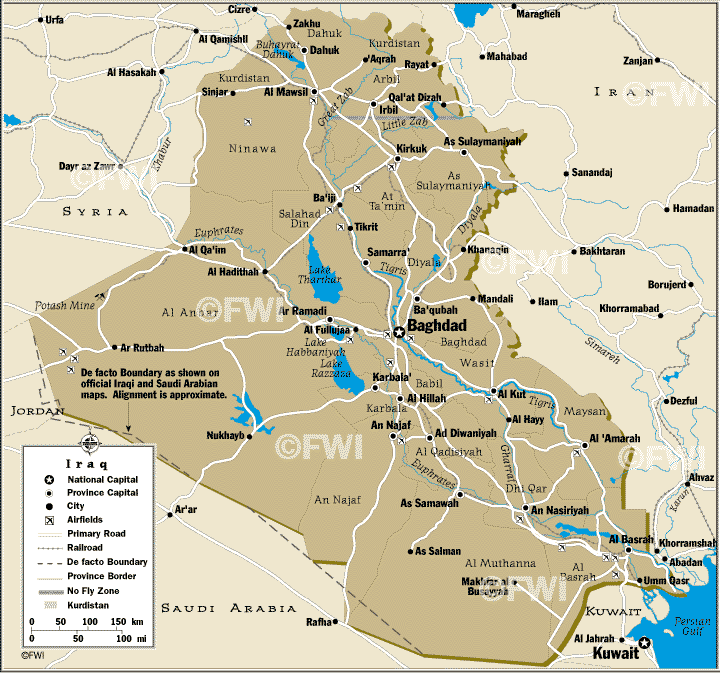
"URUK. (Iraq) Situated 250 km south of Baghdad, on an ancient branch of the Euphrates River in Iraq, known in the Bible as Erech (now Warka, Iraq). Uruk, founded about 3500BC, became the first major city in Sumer. Gilgamesh built the walls of the city Uruk, and the Eanna (house of An) temple complex there, dedicated to Ishtar (goddess of love, procreation, and war). Excavations by German archaeologists from 1912 onwards have revealed a series of very important structures and deposits of the 4th millennium BC and the site has given its name to the period that suceeeded the UBAID and prceeded the JEMDET NASR period.
The Uruk period saw the emergence of urban life in MESOPOTAMIA and led to the full civilization of the EARLY DYNASTIC period. It is not always fully realized how unique the site of Uruk was at this time: it was by far the largest settlement, with the most impressive buildings and with the earliest evidence of writing. It would be true to say that Uruk was Meso- potamia's - and the world's - first city. It seems to have started as two separate settlements, Kullaba and Eanna, which coalesced in the Uruk period to form a town covering 80 hectares; at the height of its development in the Early Dynastic period, the city walls were 9.5 km long, enclosing a massive 450 hectares, and may have housed some 50,000 people. In the heart of the city are two large temple complexes: the Anu sanctuary, belonging originally to Kullaba, and the Eanna sanctuary, dedicated to Inanna. the goddess of love. Both these complexes have revealed several successive temple-structures of the Uruk period, including the White Temple in the Anu sanctuary and the Limestone and Pillar Temples in the Eanna sanctuary. A characteristic form of decoration involves the use of clay cones with painted tops pressed into the mud plaster facing the buildings - a tcchnique known as clay cone mosaic.
On the northwest side of the Eanna sanctuary is a ZIGGURAT (an ancient Mesopotamian temple tower consisting of a lofty pyramidal structure built in successive stages with outside staircases and a shrine at the top, where the priests ruled from) laid out by Ur-Nammu of UR in the Ur III period (late 3rd millennium BC). Evidence from the deep trench excavated in the Eanna sanctuary has cast much light on the developments of the Uruk period. The most important of these was undoubtedly the development of writing. The earliest CLAY TABLETS appear in late Uruk levels; they are simple labels and lists with pictographic symbols. Tablets from slightly later levels of the Jemdet Nasr phase, show further evelorpments towards the CUNEIFORM script of the Early Dynastic period.
The city remained important throughout the 3rd millennium BC, but declined in importance during the later part of that period . It remained in occupation throughout the following two millennia, down to the PARTHIAN period, but only as a minor centre. Uruk was the home of the epic hero GILGAMESH, now thought to be a real king of the city's first dynasty, and Uruk played an important role in the mythology of the Mesopotamian civilizations to the end. "
http://home.achilles.net/~sal/iraq_history.html
http://www.piney.com/EriduGen.html
The Eridu Genesis
The following excerpt is taken from "The Harps That Once...: Sumerian Poetry in Translation" by Thorkild Jacobsen. Yale University Press, Publishers; Copyright 1987. It is related here for educational purposes only.
The Creation of the Gods
The "earth" in Genesis is not the globe. Rather, Genesis speaks of God using pillars (buckling of the land) to raise the earth or fruitful place up between the liquid waters and the waters in the atmosphere. This fruitful place or earth created a place where animal and plant life could exist. If man can evolve from matter, then the ancient mind would say that the gods can also evolve. And in the ancient literature they do, based upon the "survival of the fitest."
The Eridu Genesis is a Sumerian text. It covers the creation of the world, invention of cities and the flood. After the universe was created out of the chaos of the sea, the gods evolved and they in turn created mankind to farm, herd and worship them. Cities and kingship was created but the gods decided to destroy mankind with a flood. Ziusudra (Upnapishtim) from Eridu was instructed by Enki (Ea) to build a boat to survive the flood blown up by Enlil. After the flood he worshipped (prostrated) himself before An (Anu) and Enlil (Bel) and was given immortality for his godly life.
http://emuseum.mnsu.edu/archaeology/sites/middle_east/eridu.html
Eridu
I chose the archeological site Eridu, now known as modern Abu Shah Rain. Eridu is 196 miles southeast of Baghdad, Iraq. It was the earliest known city of Sumer (Southern Mesopotamia).There are also an important group of temples in Eridu (Britannica, 1999)
Eridu is also known for the patron god Eriki (EA), "god of the sweet waters that flow under the earth" (Britannica). Eriki's waters were essential to the fishing and irrigation. Eridu's inhabitants had a agricultural based economy. Some claim that in ancient times the city may have been linked to the sea by waterways (McDonald, 98).
Eridu was located by the mound called Abu Shayhrayan. This was one of the most important prehistoric urban centers in southern Babylonia. It was built on sand dunes probably in the fifth millennium B.C. It completely showed the sequence of the pre-literate Ubaid civilization. Eridu had a long succession of super imposed temples portraying the growth and development of intricate mud brick architecture (Britannica, 1999).
The earliest village settlement (circa 5000 B.C.) had grown into a substantial mass of mud brick and reed houses by (circa) 2900 B.C., covering the city. Eighteen super imposed mud brick temples at the site underlie the unfinished Ziggurat of Amar-Sin (circa 2047-2039 B.C.) (McDonald, 1998).
The apparent continuity of occupation and religious observance at Eridu provide convincing evidence for the (indigenous origin of Sumerian civilization. The site was excavated between 1946 and 1949 by the Iraq Antiquities Department (McDonald The city continued to be occupied until 600 B.C. but was less important in historic periods.
Some links related to the notion that Iraq is significant because of its connecion with Annunaki, Eridu, etc.
http://www.cyberspaceorbit.com/eridu.html
http://www.megspace.com/science/earthgrid/extra/esiraq.htm
http://www.geocities.com/adilbookz/palgal.html
http://www.nii.net/~obie3/000illum/history.htm
Monday, March 24, 2003

Sunday, March 23, 2003
NO QUESTION BUT THAT RUMSPEAK IS PROLIFERATING
What's with all the "but that"s?
"There's no question but that Germany is an important contributor in the global war on terrorism. "
- Rummy (not Rumi)
"There’s no question but that the strike on that leadership headquarters
was successful."
- Rummy
""There is no question
but that regime is not going to be there in the future."
- Rummy
"“The read we get on the people of Iraq is there’s no question but that they want to get rid of Saddam Hussein."
- Dick Cheney
There is no question but that we are very close to the end."
-Colin Powell
"There is no question but that anyone who looks at the threat matrix every day knows that there are threats all over the world..."
-Rummy
"There's no question but that you have Saddam Hussein who's been there and has not responded to political diplomacy... "
-Rummy
"there's no question
but that there are risks to acting, and they're real risks..."
-Rummy
...and then there is the use of nexus. Another day perhaps...
equivocation
\E*quiv`o*ca"tion\, n. The use of expressions susceptible of a double signification, with a purpose to mislead.
There being no room for equivocations, there is no need of distinctions. --Locke.
Syn: Prevarication; ambiguity; shuffling; evasion; guibbling. See Equivocal, a., and Prevaricate, v. i.
Source: Webster's Revised Unabridged Dictionary, © 1996, 1998 MICRA, Inc.
equivocation
n 1: a statement that is not literally false but that cleverly avoids an unpleasant truth [syn: evasion] 2: intentionally vague or ambiguous [syn: prevarication, evasiveness] 3: deliberate vagueness or ambiguity [syn: evasiveness] 4: falsification by means of vague or ambiguous language [syn: tergiversation]
Source: WordNet ® 1.6, © 1997 Princeton University
GoPBI.com: News Message Boards
Saturday, March 22, 2003
Friday, March 21, 2003
Thursday, March 20, 2003
Wednesday, March 19, 2003
Monday, March 17, 2003
Saturday, March 08, 2003
Friday, March 07, 2003
Tuesday, March 04, 2003
Saturday, March 01, 2003
For many people, working is just a way to murder their own lives. This book explores the vicissitudes of work in American life, and ways to cope.
Soft Skull: Murdering of My Years
Soft Skull: Murdering of My Years
Wednesday, February 26, 2003
The Village Voice: Nation: Schlock 'N' Roll: The Bushopranos by Ward Sutton
Thanks to Rob for bringing this to my attention. -Anon
Thanks to Rob for bringing this to my attention. -Anon
Sunday, February 23, 2003


Subscribe to:
Posts (Atom)